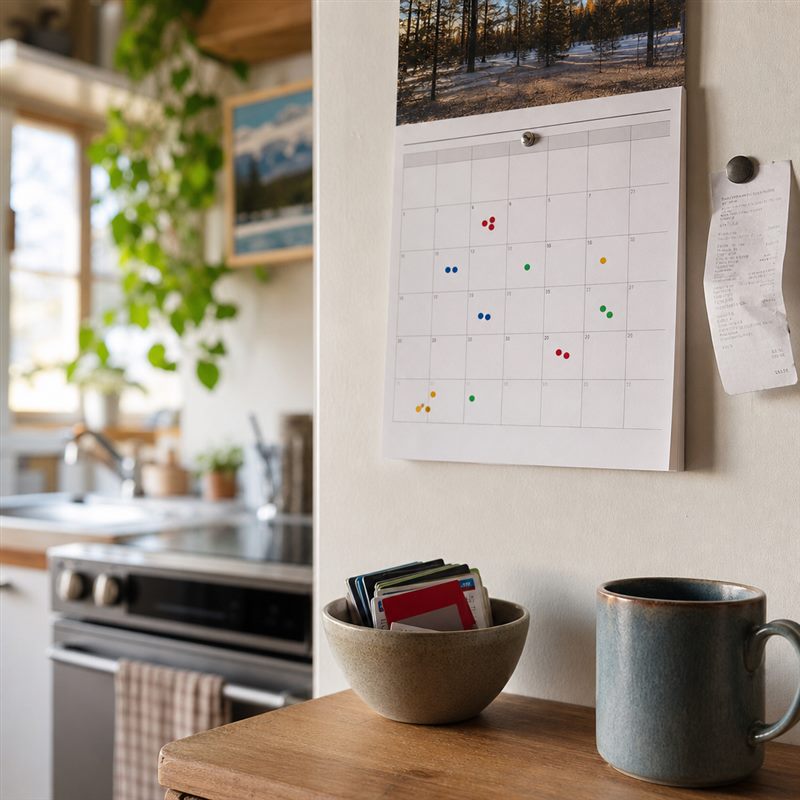
A Simple Points Expiry Calendar for Canadian Loyalty Programs is easiest to misread when the percentage is loud and the conditions are quiet. The cleaner test starts with a freelancer in St. John's saving screenshots before closing a cashback tab, then asks what would still look sensible next week.
Where this fits in a real week
The first record is the household budget note: what was already planned, where it would normally be bought, and what the household would do without the promotion. points only help when redemption is likely and the store already fits the weekly route.
The two-minute terms read
Read the terms as if you had to explain them at dinner: what qualifies, when the value arrives, what cancels it, and whether the offer works in your province or store.
If the answer depends on memory, save a calendar reminder. HappyLinkers favours offers that can be checked calmly after the purchase, not only while the banner is live.
The fridge-door version
If this had to be written on one note, it would include the store or service, the final cost, the expected reward, and the date to cancel, claim, or check the account.
- What was already needed?
- What changed because of the offer?
- Where is the proof?
- When should the household review it?
The privacy pause
Pause when the benefit is tiny but the permissions are broad: linked cards, location access, inbox scanning, or account sharing should clear a higher bar than a one-time coupon.
Good enough to repeat
Repeatable offers have short instructions and boring proof. If the benefit arrives without arguments, screenshots hidden in folders, or a surprise renewal, it can stay in the household routine.
Canadian verification notes
Check whether the offer is available in the reader's province, whether the merchant ships locally, and whether pickup or return rules change the final value. National promotions can still behave differently by region, store format, or account type.
For broader consumer context, compare the advice with public guidance from the Office of Consumer Affairs. That does not make the article legal, tax, credit, or financial advice; it simply keeps the page anchored to real consumer questions instead of affiliate enthusiasm.
How to record the outcome
After acting, write one line: what was bought or renewed, what benefit was expected, where the proof lives, and when to check the result. That tiny record turns a promotion into a household decision rather than a loose browser session.
If the benefit never arrives, the article has done its job only if the reader knows what proof to use and when to stop chasing. Not every missing reward deserves more time.
Credit, fees, and payment timing
If this topic touches subscriptions, instalments, cards, or delayed payment, the reader should check the fee, billing date, cancellation route, and what happens after a refund. Cashback after a return, trial-to-paid billing, and buy-now-pay-later reminders all deserve a calendar note.
For payment and consumer-finance context, use the Financial Consumer Agency of Canada as a public reference point. The page should stay practical: what is charged, when, and how the household exits.
Reader examples to test the advice
A student household may care more about cash flow than total annual savings. A family may care more about return windows and shared access. A freelancer may care about receipts, taxes, and whether the account creates another admin trail.
If the recommendation works for only one of those readers, the article should say so. Specific limits are a trust signal, not a weakness.
The correction file
Offers change quietly. Payout thresholds move, app permissions expand, return policies narrow, and trial pages become harder to cancel. A reader-friendly article should make those possible changes visible instead of pretending the terms are permanent.
Keep a correction trail: the date checked, the merchant or program name, the official page reviewed, and the practical detail that would change the advice. That makes later edits credible and gives affiliate managers a reason to trust the publication.
If a reader sends a correction, the response should not be defensive. The right question is simple: did the page still help someone make a careful decision today?
The shared-household version
When more than one person uses the account, the offer needs an owner. Someone should know which email is used, where the proof is saved, what happens after a refund, and whether the benefit can be used by the whole household or only by the person who clicked.
This matters for grocery points, family software, phone plans, streaming rotation, and cashback portals. A private bargain can become household clutter when nobody else knows how to cancel, redeem, or challenge it.
A good rule is to keep only the offers that another adult in the household could understand without reading the original ad. If the setup is too clever to explain, it is probably too fragile to rely on.
Affiliate-manager read
An affiliate manager should see that this page is not built only to push a click. It names reasons to skip, explains proof, points readers back to official terms, and avoids promising that every promotion is a win.
The page also gives a correction path. If a merchant changes terms, payout timing, return rules, privacy permissions, or cancellation steps, the recommendation can be revised without pretending nothing changed.
Readers should be able to compare expiry, redemption friction, privacy settings, and the ordinary basket they already buy.
Before the click
The reward should simplify a purchase already on the list, not create a new reason to shop.
If that sentence feels hard to complete, the offer is not ready. The calmer move is to keep the normal purchase path, wait for clearer terms, or choose the merchant that makes returns, cancellation, and support easier.
This is also the reader value of the page. It answers the practical uncertainty around a deal, not just the advertiser name. Readers come back to sites that help them avoid small regrets.
Editorial note
HappyLinkers is funded partly by partner links. We keep the reader-side test in the article so a household can decide without treating the click as the goal.